
Aviatrix vs Aviator: Which Crash Game Is Better in 2026?
Aviatrix and Aviator are both “crash” games. Each round starts with a low multiplier that rises in real time. You place a stake before the round begins. You can cash out at any point while the multiplier is rising. If the round ends (the “crash”) before you cash out, you lose that stake for the round.
Aviatrix and Aviator are two of the most recognizable titles in the crash games genre. Aviator is one of the original crash games that helped define the genre.
Because the core mechanic is the same, most differences sit outside the multiplier itself. The most important differences are the tools around the core round and the “meta” layer. That includes customisation, progression, rewards, and tournament systems.
This comparison focuses on what a consumer can observe and use: published RTP and max multiplier, fairness and verification, betting controls, demo options, mobile use, and the day-to-day experience. It also includes practical safety and bankroll guidance for fast, high-variance games.






Quick verdict
For most players in 2026, Aviatrix is the better choice. Not because it changes the core odds. It is better because it adds structured features that many players value once the basic crash format is familiar.
Why Aviatrix is better
It offers a progression layer with plane “skins” and level-style milestones.
It supports deeper personalisation than a single static plane theme.
It has built-in reward mechanics (such as promo-code driven features) beyond what a casino may offer by default.
It is designed around events, tournaments, and leaderboards as part of the product experience.
It tends to offer more session tools and “reasons to stop” points, such as milestones and event targets (which can help some players pace play).
Why some players still prefer Aviator
It is simpler. It has less on-screen and less to manage.
It stays focused on the single decision that defines crash games: when to cash out.
If you want the cleanest crash loop, Aviator remains a strong minimalist option. If you want a crash game that provides more structure and long-term features, Aviatrix is the more complete product.
Aviatrix vs Aviator at a glance
Both games revolve around the same risk decision. The table below highlights where the experience diverges.
Feature | Aviator | Aviatrix | Why it matters |
|---|---|---|---|
RTP (published) | Commonly listed at ~97% | Commonly listed at ~97% | RTP is a long-run average. It does not predict what happens in a short session. |
Max multiplier (headline) | Commonly listed up to 10,000× | Commonly listed up to 10,000× | A high ceiling increases variance. Very high multipliers are rare. |
Fairness model | Often presented as “provably fair” | Presented as “provably fair” | “Provably fair” only helps if you can access round data to verify results. |
Auto cash-out | Yes | Yes | Auto cash-out reduces missed clicks and supports pre-set exit rules. |
Auto bet / autoplay | Yes | Yes | Automation can reduce friction. It can also increase pace and losses if limits are not set. |
Two bets in one round | Yes | Yes | Two bets can separate a “low target” plan from a “higher target” plan. |
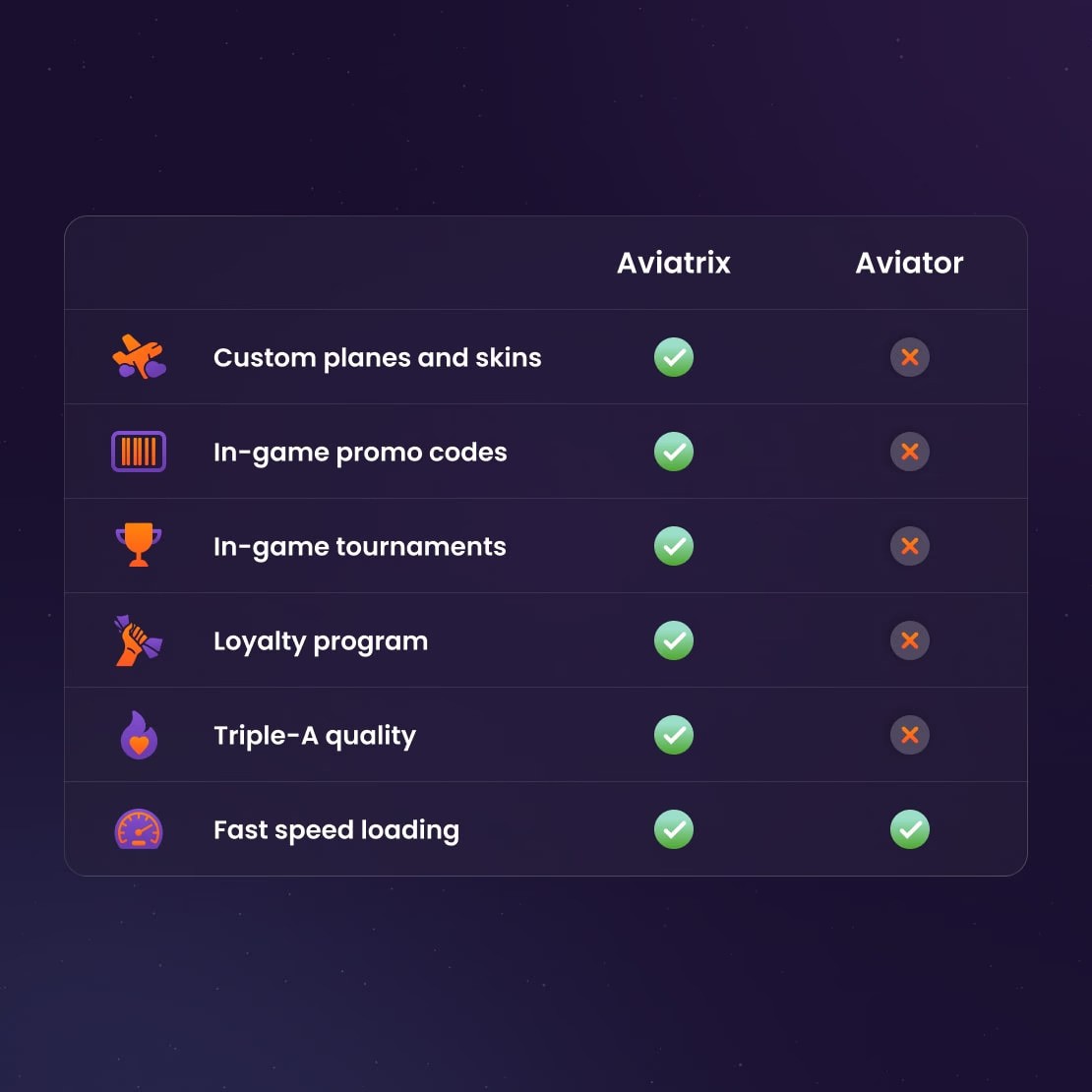
Customisation | Limited, usually static look | Strong focus (skins and cosmetic upgrades) | Customisation changes how the game feels across sessions. |
Progression | Limited or absent | Core feature (levels/XP-style milestones) | Progression adds goals beyond cashing out in a single round. |
Rewards / loyalty | Usually depends on the casino | Built-in reward mechanics are emphasised | Built-in rewards reduce dependence on a single casino promotion schedule. |
Tournaments / leaderboards | Often depends on the casino | Strong focus, including regular network tournaments | Tournaments can change why and how people play, for better or worse. |
UI/UX depth | Lean interface | More layered interface | A lean UI supports quick understanding. A layered UI supports long-term use and features. |
Demo availability | Often available via casinos | Often available via casinos; some builds promote demos directly | Demo play is the safest way to learn timing and tool settings. |
Mobile experience | Usually smooth and fast | Designed for mobile and browser play | Mobile play increases pace. Limits matter more on mobile. |
Three practical takeaways
If you value simplicity and fast rounds with minimal extras, Aviator fits that preference.
If you want customisation and progression, piloting Aviatrix is the better choice.
Whichever you pick, the operator you use matters as much as the game. Licensing, limits, and verification tools sit at the operator level.
How each game works
The round mechanics are easy to learn, but the pace can hide risk. Treat both games as high-variance gambling products. Plan your session before you start.
Both Aviatrix and Aviator allow players to place one or two bets per round, offering flexibility in betting strategies. Using betting strategies can help players manage their gameplay more effectively in both games. Players should always set their own limits to manage their bankroll effectively.
How Aviator works
Aviator is built around a clean crash loop with a small set of helpful controls.
Round flow (step by step)
Choose your stake before the next round starts.
The round begins as the plane starts flying and the multiplier rises from its starting point.
Cash out manually at any moment to lock the current multiplier for your bet.
If the crash happens first, you lose that bet for the round.
The next round starts quickly, so decisions repeat often.
Common tools and interface elements
Auto cash-out, so you can pre-set an exit multiplier.
Auto bet, so the game repeats stakes automatically between rounds.
Two bets per round, so you can run two independent exits.
A live feed that shows other players’ bets or cash-outs (depending on the version and operator).
What the simplicity means in practice Aviator’s clean design reduces distraction. It also means most “added value” comes from your own discipline, not from in-game structure. If you do not set limits, it is easy to play more rounds than intended. During gameplay, players watch the multiplier climb in real time and must decide when to cash out before the plane crashes.
How Aviatrix works
Aviatrix uses the same cash-out-before-crash format. It adds a persistent layer that carries across sessions.
Round flow (step by step)
Choose one or two stakes before the round begins.
The plane takes off into the sky and the multiplier rises.
Cash out manually, or rely on an auto cash-out setting if available.
If the crash happens before cash-out, that bet is lost for the round.
After the round, progression and reward elements can update (such as skins, levels, or event progress).
What Aviatrix adds beyond the core round
Plane skins and level-up style customisation.
Promo-code driven features tied to in-game rewards and skin distribution.
Events and tournaments presented as part of the product, not just a casino overlay.
“Meta” progression that can shape how players set goals across multiple sessions.
Players have found unique features and a provably fair system in Aviatrix, enhancing transparency and reliability.
What this means for a consumer Aviatrix gives you more to do between rounds. It can make the experience feel less repetitive. It can also increase “one more round” pressure, because progress systems create extra reasons to continue. Limits matter more, not less.
Key gameplay differences that change the player experience
Most comparisons focus on RTP and max multiplier. Those are important, but there are several things that differentiate the two games beyond just these metrics. The bigger differences are about structure and depth.
When it comes to player experience, both Aviatrix and Aviator offer the potential to win, but timing and strategy are crucial—players must decide when to cash out before the game crashes to maximize their payout.
Both games run on a Provably Fair algorithm to ensure fair gameplay.
Customisation and progression
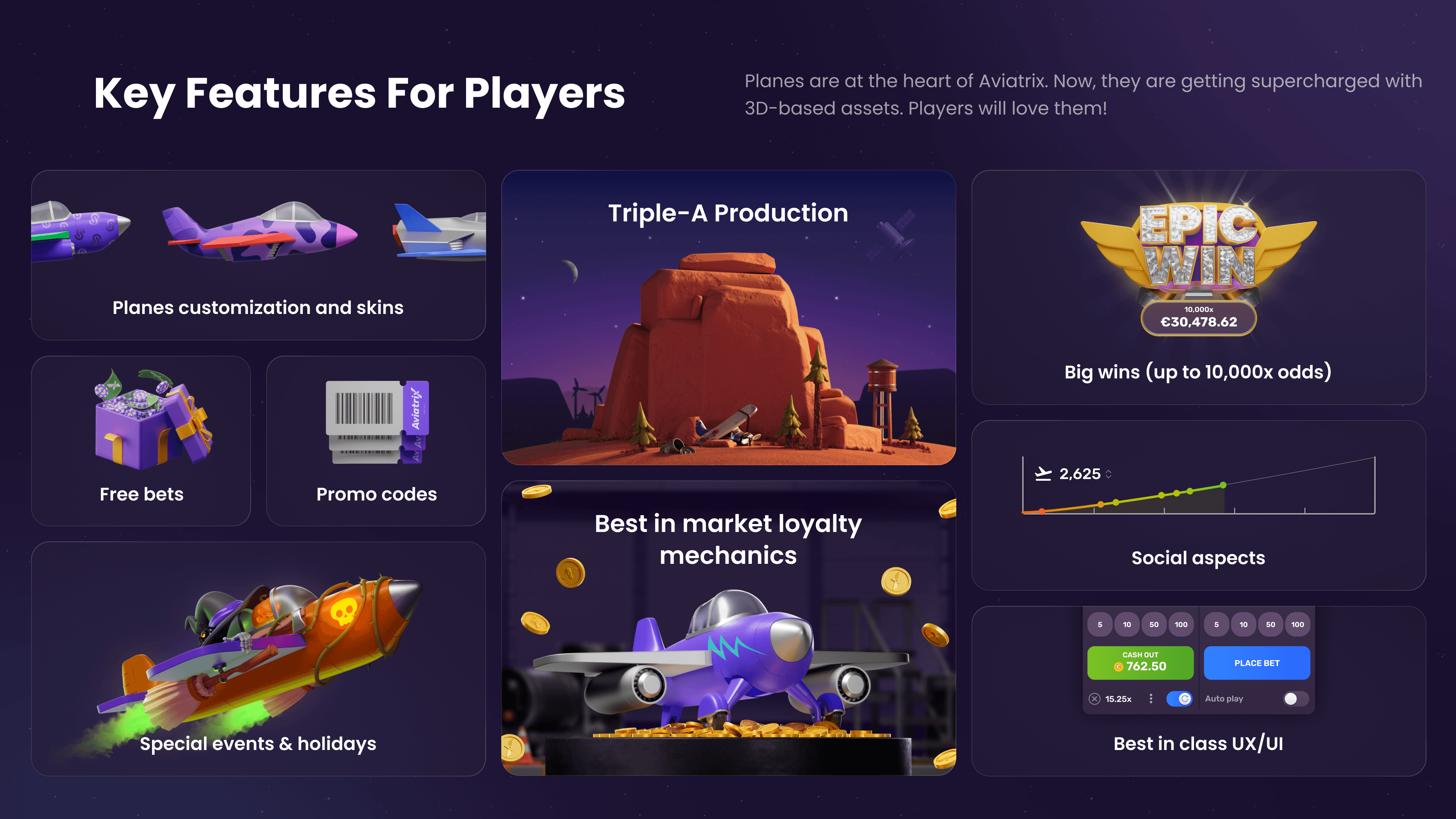
Aviatrix makes customisation a headline feature. Skins are presented as part of how the game is played over time, not as a one-off theme choice. Some skins are described as being distributed via in-game promo codes, with loot box style mechanics and a future marketplace described in official product material.
Aviator is usually closer to a fixed presentation. The “identity” layer is minimal. You do not typically manage a persistent plane collection or a level ladder.
Why this changes play
Progression gives you non-cash goals, such as unlocking a skin tier.
It can help some players keep stakes stable, because the goal is progress, not a single large multiplier.
It can also push others into longer sessions than planned, because the game keeps offering small achievement prompts.

Rewards, tournaments, and leaderboards
Aviator is generally promotion-light as a product. Rewards tend to come from the casino running the game. That can include free bets or other incentives, but it varies by operator. Aviator has been played by millions of players worldwide, highlighting its widespread popularity and appeal.
Aviatrix places more emphasis on in-game rewards and organised events. Aviatrix has a rich history of offering multi-million euro network tournaments. Aviatrix is widely accessible across various online casinos, making it available to a broad audience.
Why this changes play
Tournaments can create clearer start and stop points (“play during X event”).
They can also create urgency, which is not ideal for players who struggle with pacing.
A consumer should treat tournaments as entertainment, not as a “better odds” feature.
Betting tools and control
Both games commonly offer two-bet play and auto cash-out. Those tools matter in fast games because timing errors are common. Both Aviatrix and Aviator are available for real-money gameplay at online casinos, allowing players to bet, win, and withdraw actual money.
Aviatrix is often described as having a richer toolset and more configuration around the player’s in-round choices. Some descriptions include autoplay-style features and more visible statistics panels, depending on the operator build.
A practical control checklist
Use auto cash-out for discipline, not for chasing.
Manage your money carefully—set betting limits and use features like auto cashout to maximize potential earnings and avoid unnecessary losses.
If you use two bets, separate their purpose (one conservative, one higher risk).
If you use autoplay, set stop rules (time, loss, or number of rounds) at the operator level if possible.
Avoid changing targets rapidly after losses. That is where crash games become costly quickly.
UI, pace, and “feel”
Aviator tends to be more minimalist. That makes it easier for new players to understand. It also makes each round feel similar, which some players prefer.
Aviatrix tends to show more layers and more optional screens. This supports progression, rewards, and events. It also increases cognitive load. If you want a clean interface, Aviator is often easier to live with. But for the world's most immersive crash experience, Aviatrix is the best bet.
Safety, fairness, availability, and starting safely
The safest way to compare these games is to separate three topics: outcome fairness, operator safety, and legal availability.
For a more tactical angle, these crash game strategies are worth reviewing too.
Randomness and “provably fair” in plain language
A crash game produces a crash point. In regulated online gambling, outcomes are expected to be random and not adapted to players’ past results. Some crash games also use “provably fair” methods. That is a verification approach borrowed from cryptographic systems. Both Aviatrix and Aviator use a provably fair algorithm to guarantee fairness and transparency for players, allowing anyone to verify the outcome of each game.
In a typical provably fair setup:
The system uses a server seed plus player-controlled or player-influenced inputs.
Each round has a unique counter (often called a nonce).
After the round, the game reveals enough data for you to verify that the crash point matches the pre-committed inputs.
This does not let you predict the next round. It only lets you check past rounds. If a game calls itself provably fair but gives you no seeds, hashes, or verification screen, treat the claim cautiously.
A short safety checklist
Use a licensed operator for your location.
Find and set deposit and time limits before the first bet.
Prefer demo mode for learning tool settings and pace.
If “provably fair” is offered, confirm you can access round verification data.
Avoid “predictor” tools and apps. Treat them as scams.
Stop when your time limit or loss limit is reached.
Practical risk management and how to use demos
Crash games feel simple. The risk comes from speed and variance. A plan reduces both. Managing your gameplay is much like managing a career—both require careful planning, discipline, and knowing when to take calculated risks to achieve your goal.
In practical terms, set a clear goal for each session and stick to it. Know when to end your session to avoid unnecessary losses, just as you would recognize the right time to conclude a phase in your career or a flight.
Bankroll approaches that fit crash games
You need a stake size that can absorb losing stretches. In crash games, low multipliers happen often. Long losing runs are possible.
Approach | Risk profile | Who it suits |
|---|---|---|
Flat staking (same stake each round) | Lower | Beginners and anyone prioritising session stability. |
Percentage staking (fixed % of bankroll) | Medium | Players who want stakes to fall after losses and rise slowly after wins. |
Martingale (increase stake after losses) | High | Not recommended for most players. It can escalate fast and hit limits. |
Practical rules that scale
Decide your maximum session loss before you start.
Decide your session length in minutes, not in “number of wins”.
Use auto cash-out to pre-commit, not to react.
If you feel urgency, stop. Urgency is usually a sign your plan has broken.
Where to play and how to choose a site
Both games are typically offered inside online casino platforms, not as standalone apps you should download from random links.
A consumer-focused selection process
Confirm the operator is licensed for your location.
Check that the operator offers clear safer gambling tools.
Look for published RTP information or game info screens.
Test the game in demo mode first if available.
Only then move to small stakes, using a time limit.
How to use demo mode properly
Demo play is most useful when you treat it as training, not as entertainment.
Use demos to:
Learn how quickly rounds cycle.
Test auto cash-out settings.
Test two-bet setups without financial pressure.
Observe how often low multipliers occur, without drawing “patterns”.
If a site does not offer demos and pushes you straight into deposits, that is not a positive signal. It is not always a deal-breaker, but it increases risk for new players.
Aviator is a good crash game if you want the simplest version of the format. It is quick to understand and easy to operate. That simplicity is its main advantage.
Aviatrix is the better overall choice in 2026 for most consumers because it adds factual product depth: customisation through skins, progression systems, and built-in rewards and tournament features that can make sessions feel less repetitive. If you want a crash game with a longer-term structure, Aviatrix offers more without changing the underlying risk of the crash mechanic.
You can also compare Aviatrix with other games in our related comparison articles:
What is the main difference between Aviatrix and Aviator?
Aviatrix adds a persistent feature layer, such as skins, progression, rewards, and tournaments. Aviator stays closer to the basic crash loop with fewer long-term systems. Choose based on whether you want depth or simplicity.
Do Aviatrix and Aviator have the same RTP?
Both games have an RTP of around 97%. The exact value can depend on the operator and the specific build. Treat RTP as a long-run statistic, not a session prediction.
Do Aviatrix and Aviator have the same max multiplier?
They are often listed with the same headline ceiling, commonly up to x10,000. In practice, very high multipliers are rare in any crash game. Use a plan that assumes you will see mostly low outcomes.
Are Aviatrix and Aviator “provably fair”?
Both are commonly described as provably fair. That matters only if you can access the verification screen and the data needed to audit past rounds. If you cannot verify anything, rely on operator licensing and independent testing instead.
What is auto cash-out, and should I use it?
Auto cash-out exits your bet automatically at a set multiplier if reached. It reduces missed clicks and supports discipline. Use it as a limit tool, and do not keep raising the target after losses.
Can I place two bets in one round?
Many versions of both games support two bets in a single round. This can help you separate a low-target plan from a higher-target plan. Keep both stakes small enough that a short losing run does not break your session budget.
Does Aviatrix have customisation and upgrades?
Yes. Aviatrix is known for its customisation options. As you earn XP with your plane, you can customise it further ahead of flights. If personalisation matters to you, Aviatrix is clearly stronger.
Does Aviatrix offer tournaments and rewards?
Yes. Aviatrix runs regular tournaments, leaderboards, and promo-code driven rewards. Network tournaments often have prize pools of several million euros.
Can I play demo modes of Aviatrix or Aviator?
Often, yes, but it depends on the casino. Demo mode is the safest starting point because it lets you test pace and tool settings without deposits. If you are new, use a demo before real play.